







A field sales rep rarely has just one job anymore. They take orders, answer product questions, check inventory, follow up on unpaid invoices, build displays, photograph shelves, and somehow stay on schedule between customer visits. Software should make those days easier, not add another layer of administration.
The market is full of platforms promising to improve sales productivity, but they don’t all solve the same problems. Some focus almost entirely on customer relationship management. Others lean toward route planning or order entry. A handful combine sales with deliveries, merchandising, and retailer ordering.
If you’re comparing field sales software, start by looking at your team’s daily routine instead of the feature list.
Here are six platforms worth considering.
1. SimplyDepo
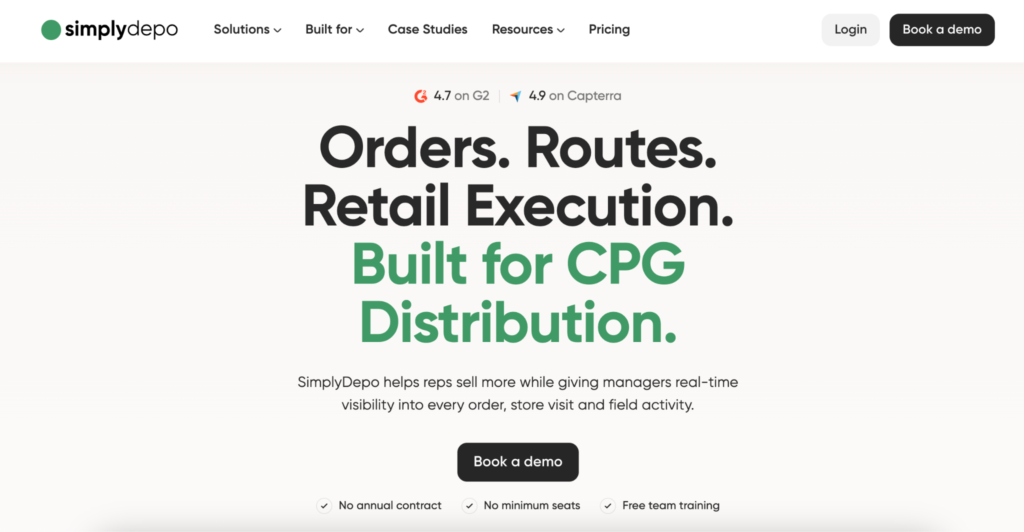
For many distributors, a customer visit doesn’t end after an order is placed. Products still need to be delivered, invoices created, payments collected, and shelves checked before the rep heads to the next account.
SimplyDepo is designed around that reality. Instead of treating field sales as a standalone activity, it connects sales with the rest of the direct store delivery process. Reps can complete multiple tasks during a single visit while customer data flows directly into QuickBooks Online.
The result is less switching between apps and fewer manual updates once the team returns to the office.
Some of the platform’s strongest features include:
- Mobile order capture
- Customer visit management
- Route planning
- Van sales
- Mobile invoicing
- Proof of delivery
- Shelf audits
- Planogram compliance
- Branded B2B ordering portal
- Offline mode
- Native QuickBooks Online sync
SimplyDepo doesn’t try to be a generic CRM. It’s built for businesses where field sales, deliveries, and merchandising all happen as part of the same operation.
Best fit for
Self-distributing CPG brands and wholesale distributors looking to manage sales, deliveries, and retail execution through one mobile platform.
2. Skynamo
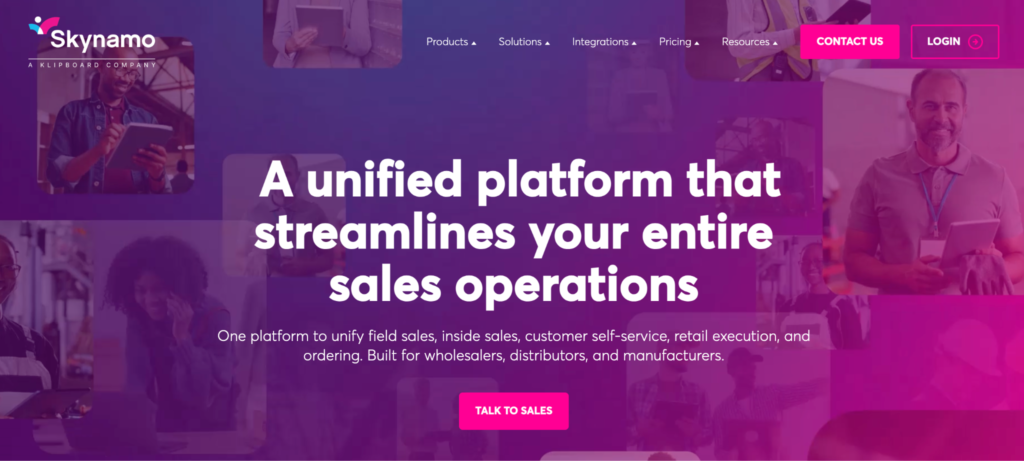
Skynamo takes a more sales-focused approach. The platform helps representatives organize customer visits, access product information, capture orders, and maintain detailed account histories while working in the field. Offline functionality and GPS tools make it especially useful for teams spending most of their day on the road.
It integrates with several business systems, allowing companies to improve field productivity without replacing their existing ERP.
Highlights include:
- Mobile order entry
- Customer visit scheduling
- GPS tracking
- Offline access
- Product catalogs
- CRM functionality
- ERP integrations
- Sales reporting
The software puts customer relationships at the center of the experience. Delivery management and retail execution aren’t its primary focus, which may actually be an advantage for organizations looking for a dedicated field sales solution.
Consider it if
Your sales team spends significantly more time selling than managing deliveries or merchandising activities.
3. Pepperi
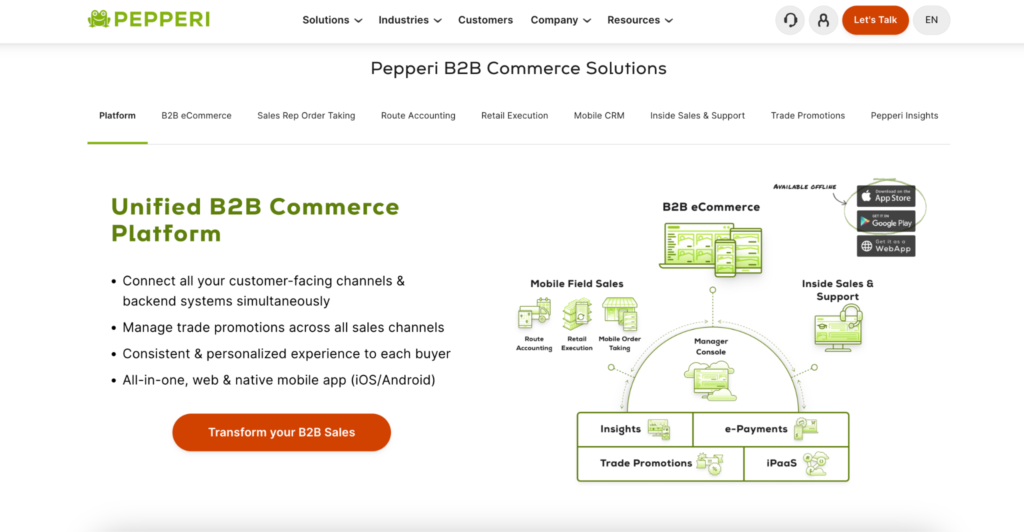
Pepperi has earned its reputation by serving larger organizations with more complex sales operations.
Instead of offering fixed workflows, it allows businesses to configure pricing rules, approval processes, customer catalogs, promotions, retail execution, and sales activities around their existing business model. That flexibility becomes valuable as teams grow across regions or product lines.
It’s a powerful platform, though it asks for more time during implementation than many cloud-first solutions aimed at smaller distributors.
Key capabilities include:
- Mobile field sales
- B2B commerce
- Retail execution
- Customer-specific pricing
- Workflow automation
- Advanced reporting
- Multi-language support
- ERP integrations
Pepperi is built for businesses that expect their software to adapt to established processes rather than the other way around.
A strong option for
Enterprise distributors managing large field teams, multiple territories, or sophisticated ERP environments.
4. Orders in Seconds (OIS)
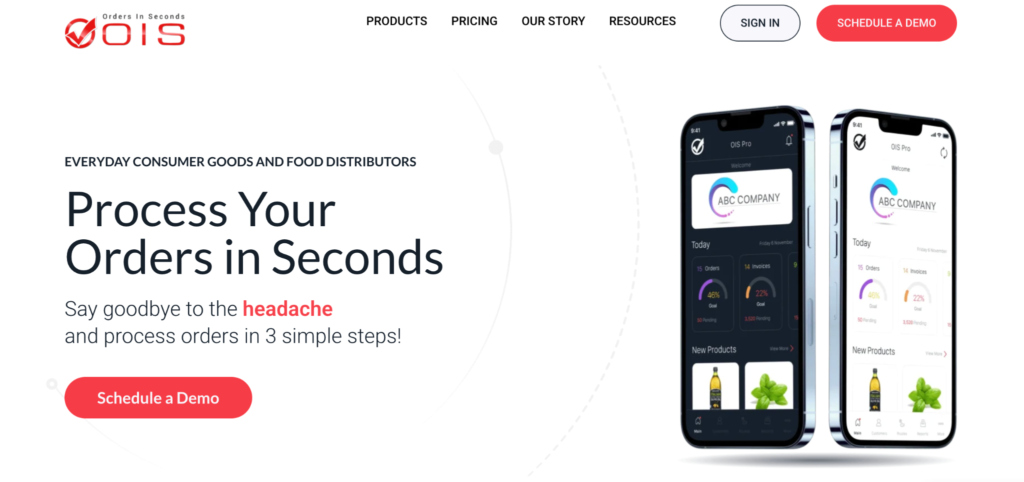
Orders in Seconds has always kept its attention on the people actually visiting customers. The platform is designed to help field representatives capture orders quickly, access product information, manage customer accounts, and continue working even without an internet connection.
That straightforward approach has earned it a loyal following among distributors who don’t need a large enterprise system.
Another advantage is its support for both QuickBooks Online and QuickBooks Desktop, making it a practical option for businesses that haven’t moved entirely to cloud accounting.
Features include:
- Mobile order entry
- Customer management
- Offline functionality
- Digital product catalogs
- Route sales support
- QuickBooks Online integration
- QuickBooks Desktop integration
- Sales reporting
Orders in Seconds doesn’t try to replace every operational system. Instead, it focuses on making field sales faster and more organized, which will appeal to teams whose primary responsibility is generating orders rather than managing deliveries or merchandising.
Worth considering when
Your business already has established delivery processes and simply needs a reliable mobile sales application that works well with QuickBooks.
5. inSitu Sales
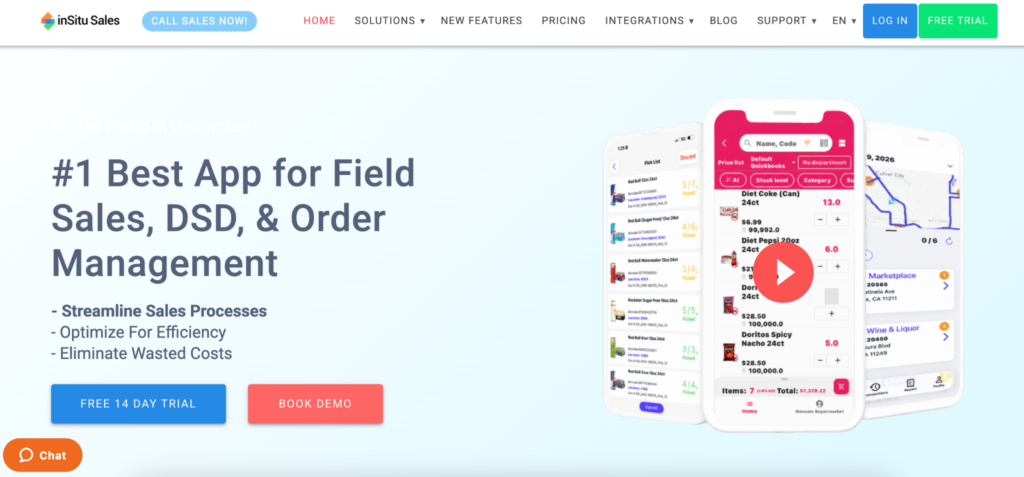
Some distributors prefer software that covers more than customer visits alone. inSitu Sales combines field sales with dispatching, warehouse management, inventory control, and delivery operations. That wider scope can reduce the need for additional operational software, especially for businesses managing their own warehouse and delivery fleet.
The platform also supports multilingual teams, making it attractive for distributors operating in diverse markets.
The platform offers:
- Mobile sales
- Warehouse management
- Dispatch tools
- Inventory control
- Delivery management
- Route scheduling
- Customer management
- English and Spanish support
Rather than specializing in retail execution or customer portals, inSitu focuses on helping distributors coordinate daily operations from warehouse to customer delivery.
Designed with these teams in mind
Distributors that want warehouse operations and field sales managed within the same platform without moving to enterprise-level software.
6. RouteStar Solutions
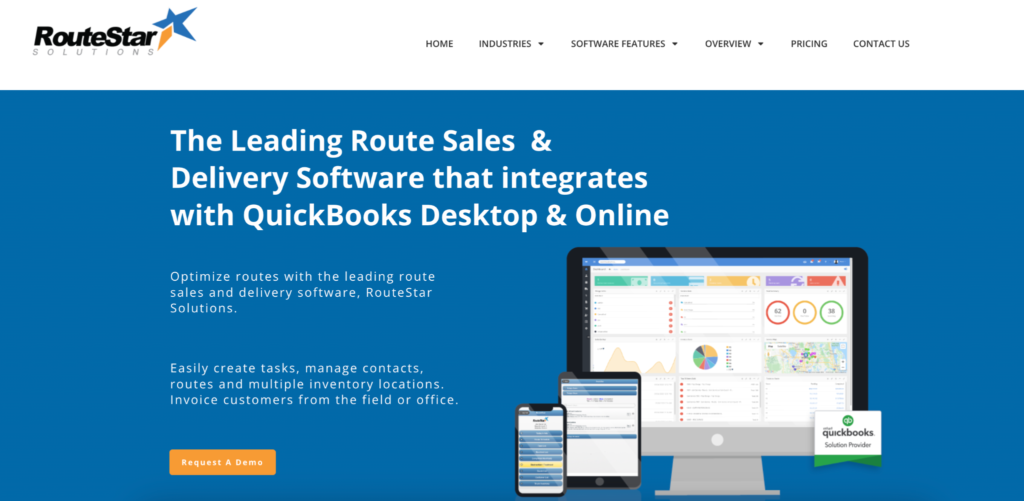
If QuickBooks sits at the center of your business, software compatibility quickly becomes one of the biggest buying decisions.
RouteStar Solutions has built its platform around that reality. It focuses on route accounting, truck inventory, delivery management, invoicing, and customer servicing while maintaining strong synchronization with QuickBooks.
For businesses that don’t want unnecessary complexity, that specialization can be an advantage.
Its core functionality includes:
- Route accounting
- Truck inventory
- Mobile invoicing
- Delivery tracking
- Route mapping
- Customer portal
- Two-way QuickBooks synchronization
RouteStar isn’t trying to become a CRM, merchandising platform, or enterprise commerce solution. Its attention stays on delivery operations, making it a better match for distributors with relatively straightforward field processes.
Best suited to
Small and mid-sized distributors looking for dependable route accounting and QuickBooks integration without paying for features they may never use.
Features That Matter More Than GPS Tracking
GPS tracking appears on almost every field sales software checklist today, but it’s rarely the feature that transforms daily operations.
The biggest productivity gains usually come from eliminating repetitive work. Reps shouldn’t have to enter the same customer information twice or wait until they’re back at the office to finish paperwork. Offline access, automatic synchronization, mobile invoicing, and customer history often have a much bigger impact than seeing vehicle locations on a map.
It’s also worth paying attention to how different features connect. Order capture, inventory updates, invoicing, and customer records become far more valuable when they happen inside the same workflow instead of across several disconnected systems.
Common Mistakes Companies Make When Buying Field Sales Software
One of the biggest mistakes is buying software based solely on today’s problems.
A company might choose a platform because it captures orders well, only to realize six months later that deliveries, inventory, and accounting still rely on separate tools. Growth usually exposes those gaps much faster than expected.
Another common mistake is overlooking implementation. The most powerful platform isn’t always the best investment if your team needs months of configuration before they can start using it. For many distributors, software that matches existing workflows will deliver better results than a system packed with features that never get used.
FAQ
What is field sales software?
Field sales software helps representatives manage customer visits, capture orders, access product information, and update customer records while working outside the office.
Is field sales software different from DSD software?
Yes. Field sales software focuses on selling and customer management, while DSD software often includes deliveries, route planning, invoicing, inventory, and proof of delivery.
Should field sales software work offline?
For most distributors, yes. Representatives frequently visit customers in locations with limited internet connectivity.
What integrations are most important?
Accounting software, ERP systems, inventory management, and CRM integrations are usually the most valuable because they reduce duplicate data entry.
Choose the Workflow That Fits Your Sales Team
The right field sales platform isn’t necessarily the one with the longest feature list. It’s the one your team will actually use every day.
Some businesses need a focused mobile sales application. Others benefit from connecting field sales with deliveries, accounting, merchandising, and customer ordering. Understanding where your sales process begins—and where it ends—will make the decision much easier.